
The ECtA Accountability Method
An Accountability Method that delivers
The ECtA method was created by Karina Kampe and Maria Wronski-Ellis, two creative solo entrepreneurs who needed exactly what they ended up building: a focused coaching method where you meet with peers who are like you, in an international community setting, and move forward step by step. Grounded in a bachelor’s thesis in Psychology and tested with fourteen creative solo entrepreneurs across six countries, ECtA is a method with both heart and evidence behind it.
ECtA gives you:
- A structure that gives you freedom to map out your way forward, step by step
- A weekly rhythm that makes progress sustainable
- Momentum that feels human, real, and always aligned with your vision
Rooted in real meetings, shared reflection, and weekly rhythms, the method keeps you focused on what matters, without adding noise to your week. Simple. Grounded. Repeatable. Human.
The Study
Fourteen creative solo entrepreneurs from six countries took part in a twelve-week intervention, meeting regularly in small peer groups. Their experiences were studied before and after the program through semi-structured group interviews.
What participants described before the program
Five patterns emerged consistently:
- A fleeting momentum — felt as ease and flow, but gone without warning
- A popcorn brain — juggling roles as artist, marketer, accountant, salesperson and project manager all at once, with everything feeling urgent and nothing quite landing
- The lone wolf — forced isolation, with no one to mirror the work back
- A glass lid — finished work held back from the world by self-doubt rather than any external barrier
- A search for higher purpose — what kept people going when self-doubt was loudest
What changed
The demands of daily life had not changed. What changed was how participants related to them.
One participant had spent twenty-five years hesitant to call herself a songwriter, despite writing and performing for that long. Through the group’s reflections, she found the words finally felt true:
“It definitely has fed back into me being more confident about, yeah, I am a songwriter. I am. That’s something that I’ve been building up on for like, oh gosh, 25 years, to sort of have that, and not have that imposter syndrome. I am these things.”
Another put words to what the meetings actually gave back:
“That hour and a half that feels like it’s taking away from what I have to do is not taking away. It’s giving far more to what I have to do.”
And for many, the clearest throughline was purpose, the sense that the work mattered to someone beyond themselves:
“When I feel that what I’m doing is useful for others, then I feel that momentum keeps there very strongly.”
The research behind ECtA
ECtA is the subject of a bachelor’s thesis in Psychology at Mid Sweden University (Mittuniversitetet), conducted by Karina Kampe in 2026. The study examined how structured accountability meetings affect momentum and goal achievement for creative solo entrepreneurs, drawing on four complementary theoretical frameworks:
- Self-Determination Theory (Deci & Ryan, 1985), examining autonomy, competence, and belonging
- The Job Demands-Resources model (Bakker et al., 2023), examining the balance between what work demands and what resources support it
- The Progress Principle (Amabile & Kramer, 2011), examining how small, perceived wins drive motivation
- Flow theory (Csikszentmihalyi, 1990), examining deep engagement in creative work
A complementary lens, Antonovsky’s sense of coherence (1991), helped interpret how meaningfulness, manageability, and comprehensibility shaped participants’ wellbeing throughout the process.
Who’s behind the ECtA Accountability Study
Karina Kampe is a certified coach and mental trainer, with a Bachelor’s degree in music performance from Berklee College of Music, Boston. She has created goal plans for organizations and individuals for over 15 years, and co-hosts the podcast Big Dreams & Little Things. ECtA grew out of her own need, alongside fellow Berklee Alumni Maria Wronski-Ellis, to maintain momentum in creative work, and has since become the subject of her academic research at Mittuniversitetet.
Curious to try it yourself?
IGNITE, our twelve-week program, starts in September 2026.
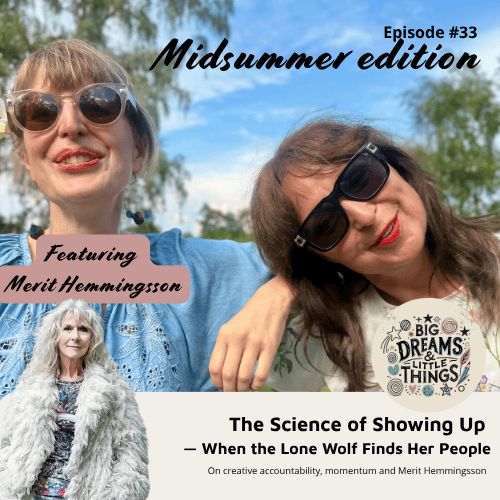
Listen to the podcast episode where Karina explain the results of the Accountability study
FAQ
How Does ECtA differ from regular coaching?
ECtA isn’t one-on-one coaching, and it isn’t a course you work through alone. It’s structured peer accountability: you meet regularly with a small group of fellow creative solo entrepreneurs, following a clear, repeatable format that keeps every session focused. There’s no coach steering the conversation. Instead, the structure itself, the bi-weekly rhythm, and the people who show up with you do the work. You set your own goals, you get the same focused time, and you’re surrounded by people who understand the specific challenges of creative work.
Has it been proven?
ECtA is grounded in a bachelor’s thesis in Psychology at Mid Sweden University, where the method was studied with fourteen creative solo entrepreneurs over a twelve-week intervention. Their experiences were tracked before and after the program, drawing on established research frameworks like Self-Determination Theory and the Job Demands-Resources model. The findings point to real shifts in momentum, confidence, and a sense of purpose. It’s not a massive clinical trial, but it’s real, structured research, not just anecdotes.
How can I try it?
IGNITE, our twelve-week program built on the ECtA method, starts in September 2026.
