
Episode 31 - Pricing Your Worth: The Money Conversation Every Creative Needs to Have
feat. Taylor Swift, TLC and Backstage guest Elin Ruth Sigvardsson
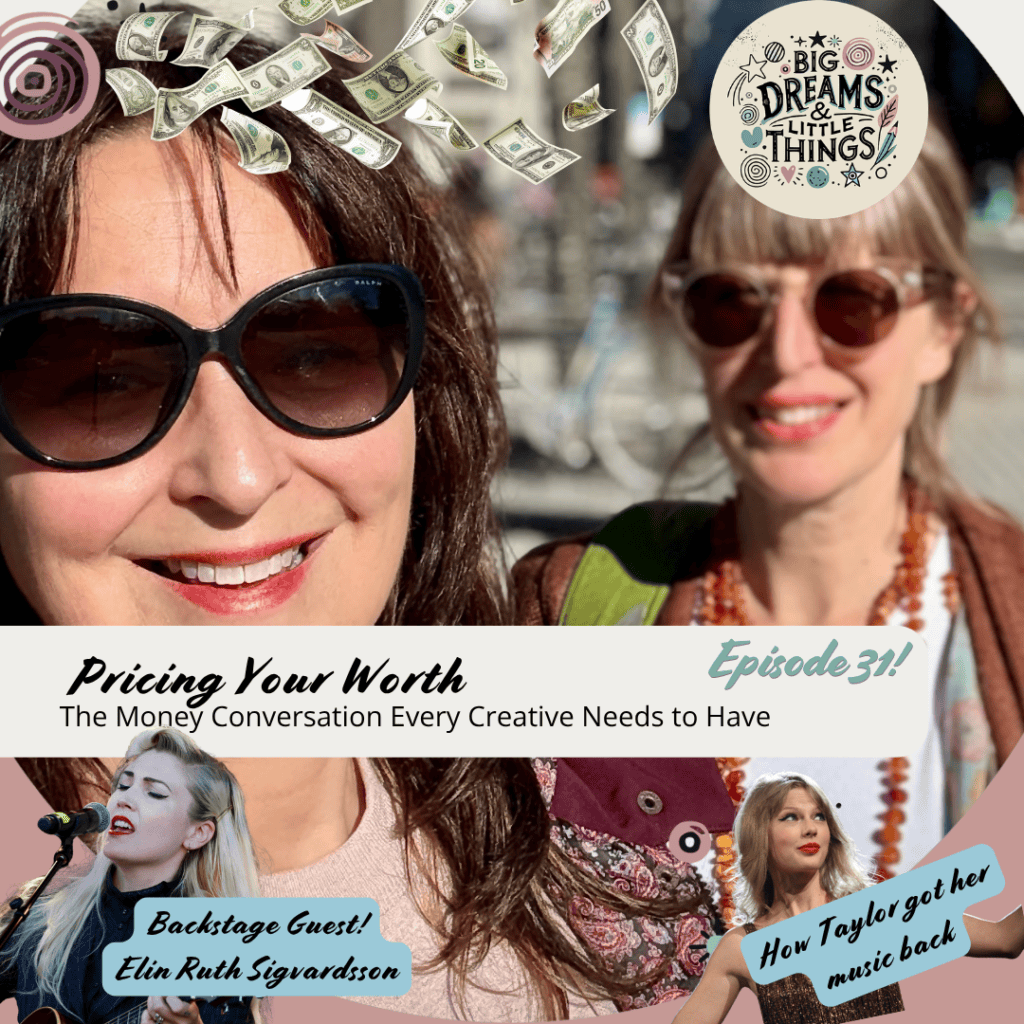
Episode Overview
Someone asks what you charge. And you tell them. No anxiety. No wondering if you are correct. Just you, knowing your worth.
This episode is the money conversation every creative needs to have. Why pricing feels impossible when what you are selling is so personal. What happens when you sign a deal before you understand what it means. And how to walk into any pricing conversation and feel good about what you are doing.
We tell the full story of Taylor Swift, from a Christmas tree farm in Pennsylvania to buying back every note she ever recorded. We look at TLC, Prince, Billy Joel and Dolly Parton. We dig into the psychology of pricing and what it really means to sell results, not hours. And we share concrete tools for the cold call, the negotiation, and the contract.
Plus Backstage Community with singer-songwriter and producer Elin Ruth Sigvardsson — on self-doubt, stage fright, the break from music that taught her everything, and how she learned to celebrate her wins.
And a free Pricing Conversation Guide to download — something to have in front of you during your next sales call.
Topics Covered
- Why pricing feels so personal and hard for creatives — and the comparison trap
- Money as one of the biggest energy drains for creative entrepreneurs
- Taylor Swift: from Christmas tree farm to owning every note she recorded
- The AI clause every creative needs in their contracts right now — the Robbie Williams example
- Tips for setting your price
- Cold Calls and how to handle them
- Never lower your price
- Backstage Community: Elin Ruth Sigvardsson
- Free download: the Pricing Conversation Guide
Time Stamps
00:00 Hook & teaser
01:03 Welcome & weekend check-in (Wizard of Oz)
02:39 Today’s topic: pricing & negotiation
03:53 Why pricing feels hard for creatives
04:53 The wine vs. live music comparison
07:55 Backwards pricing & calculating what you need
09:39 Story: Taylor Swift – knowing your worth
15:09 Discussion: lessons from Taylor’s story
15:32 Cautionary tales: TLC, Prince, Billy Joel
19:01 Getting equity vs. selling hours
20:33 The AI clause – essential in 2026
22:00 The Science: psychology of pricing
22:20 The anchoring effect
25:34 The paradox of value (effort vs. outcome)
28:32 Never lower your price – offer a discount instead
30:08 Backstage Community: Elin Ruth Sigvardsson
36:57 Takeaways
38:18 Outro & Victory Dance
Backstage Community: Elin Ruth Sigvardsson
Elin Ruth Sigvardsson is a Swedish singer-songwriter, producer and musician. She has released several albums with original music, lived and worked in Stockholm and New York, and is currently based in Malmö. She plays guitar and backup vocals in the band Yvette Eklundbanden — and has a new Swedish-language album on the way this fall.
She talks about what keeps her creating, self-doubt and stage fright as the biggest enemy of creativity, what she wishes more creatives talked about honestly, and how she learned — from her daughter — to actually celebrate her wins.
Instagram: @elinruthmusic Facebook: Elin Ruth Sigvardsson
References & further reading
Science Links for the Episode
We talked about why pricing feels so hard for creatives, and a lot of it comes down to three well-documented effects from behavioural psychology.
The anchoring effect. The first number someone hears becomes the reference point for everything that follows. Tversky and Kahneman demonstrated this back in 1974, and it has held up across decades of research. It is why starting with your full rate matters, and why a discount from a higher anchor feels generous, while a low starting price simply lowers expectations. Read more: https://en.wikipedia.org/wiki/Anchoring_effect
Price as a quality signal. Higher prices raise the perceived quality of a product or service, even when the work is identical. Recent research by Kurz and colleagues (2023) confirms what marketers have known for years: pricing low does not attract more clients, it signals lower value. Read more: https://onlinelibrary.wiley.com/doi/full/10.1002/mar.21799
The IKEA effect, or the paradox of value. This one explains why pricing your own work feels so impossible. Norton, Mochon and Ariely (2012) showed that we overvalue the things we create ourselves because we see every hour, every draft, every late night that went into them. The catch is that clients see only the result, not the process. They pay for outcomes, not effort. Recognising this gap is one of the most useful shifts a creative can make. Read more: https://www.sciencedirect.com/science/article/abs/pii/S1057740811000829
Anchoring effect
- Original source: Tversky & Kahneman (1974), “Judgment Under Uncertainty: Heuristics and Biases” — Wikipedia overview with the original experiments: https://en.wikipedia.org/wiki/Anchoring_effect
- Accessible walkthrough of how anchoring shapes decision-making: https://www.nelson.edu/thoughthub/education/the-affects-of-anchoring-bias-on-human-behavior/
- Marketing application with the classic Williams-Sonoma bread maker example (the $275 / $429 pricing case): https://www.leadalchemists.com/marketing-psychology/anchoring-effect/
- Research study on anchoring in pricing decisions specifically: https://www.frontiersin.org/journals/psychology/articles/10.3389/fpsyg.2022.794135/full
Higher price signals higher quality
- Kurz et al. (2023), “Pricey therefore good?” in Psychology & Marketing — recent study showing that higher prices raise quality expectations: https://onlinelibrary.wiley.com/doi/full/10.1002/mar.21799
- Verma & Gupta (2004), “Does Higher Price Signal Better Quality?” — classic study: https://journals.sagepub.com/doi/pdf/10.1177/0256090920040206
- “The Price-Quality Relationship Revisited” — shows higher prices signal higher quality especially for branded goods: https://www.researchgate.net/publication/229580205_The_Price-Quality_Relationship-Revisited
The paradox of value (why we overvalue our own work — the IKEA effect) This is the one I found most exciting, because it explains exactly what you describe: creatives see all the effort behind the work, while clients only see the result.
- Norton, Mochon & Ariely (2012), “The IKEA effect: When labor leads to love” — the original study in Journal of Consumer Psychology: https://www.sciencedirect.com/science/article/abs/pii/S1057740811000829
- Free PDF of the working paper from Harvard Business School: https://www.hbs.edu/ris/Publication%20Files/11-091.pdf
- Plain-language summary: https://insidebe.com/articles/the-ikea-effect/
- Wikipedia overview: https://en.wikipedia.org/wiki/IKEA_effect
Find Us
Website: ectahub.net Newsletter: ectahub.net/backstage Instagram: @bigdreamsandlittlethings Facebook: @bigdreamsandlittlethings YouTube: @bigdreamsandlittlethings