
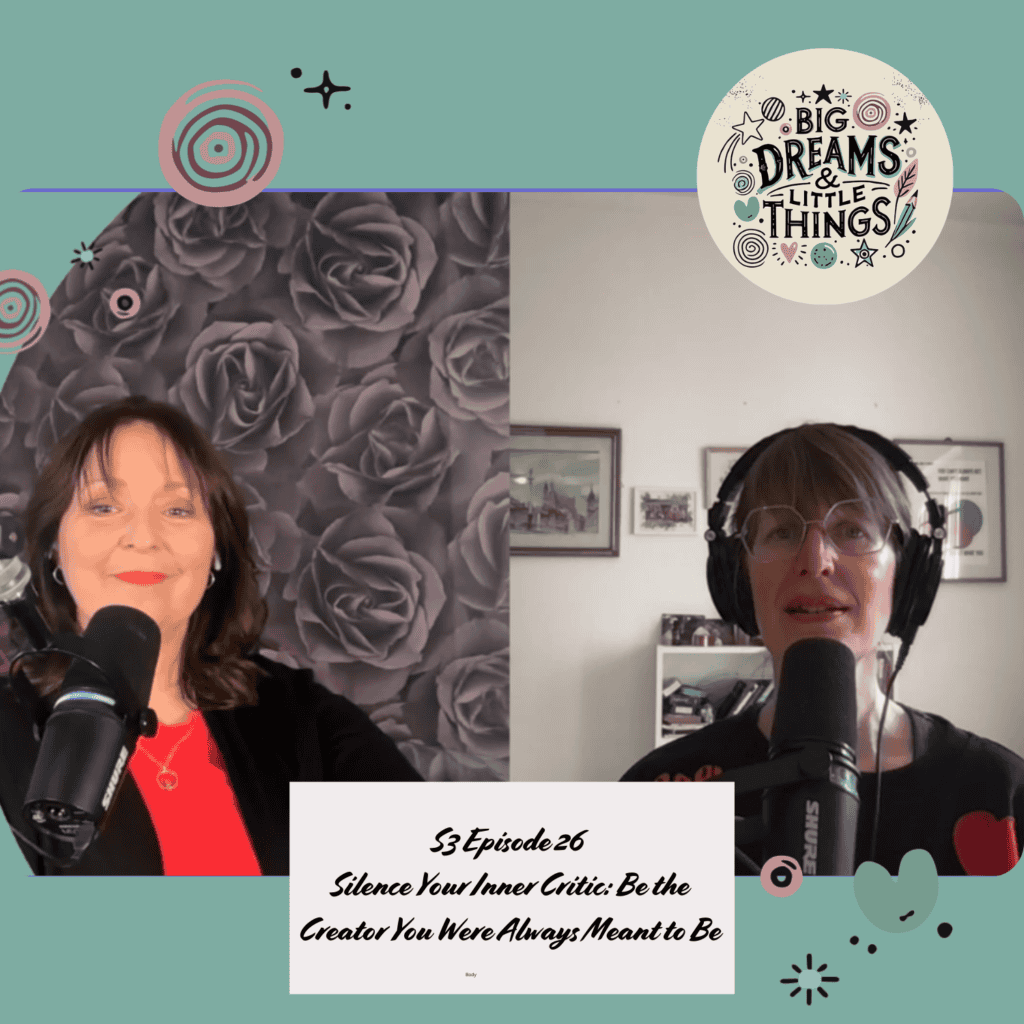
Episode 26 - Silence Your Inner Critic:Be The Creator You Were Always Meant To Be
Why Your Unique Perspective Is Your Greatest Creative Asset
Episode Overview
What happens when the world tells you to find your creative voice… and then immediately asks you to adjust it so it sells?
In this episode of Big Dreams & Little Things, hosts Karina Kampe (certified transformational coach, artist, creative entrepreneur, and songwriter) and Maria Wronski-Ellis (artist, songwriter, educator, and author of the upcoming book The Mindful Songwriter) explore the delicate balance between authenticity and expectation.
Through the story of Swedish pop icon Robyn, they unpack what it really takes to stay true to your creative instincts – even when the industry, the algorithm, or your own inner critic suggests a safer path.
Topics Covered
Why the music industry often rewards imitation
The story behind Robyn’s independent path
How artists like Britney Spears and Robyn experienced different sides of the industry
Brain science and creativity – The Default Mode Network (DMN) and creative insight
Practical tools for reconnecting with your creative instincts
Time Stamps
00:00 Introduction of today’s topic
03:34 Introduction of today’s topic, talking today about how to express what’s inside without being influenced with the world around you and childrens creativity
04:37 Karina Spring break activities and plaing like a 6 year old.
05:20 This week’s story we’re talking about the Swedish artist Robyn
10:58 Discussion on the Roby story
12:01 Britney Spears tragic story
13:44 Robyn sexistential Single
14:41 People think that as a singer it’s all about the fame
15:51 Science section-The DMN-Default mode network
18:56 Trusting your innate creativity
21:15 Favourite Robyn song
21:54 Weekly takeaway – The creative voice finder
23:09 Backstage community – Karina Kampe
26:35 Episode takeaways
27:49 Next Episode
28:35 Victory Dance
References & further reading
Robyn – the independent pop visionary behind Dancing On My Own.
Three Small Giants – Karina’s Trio.
The Default Mode Network & Creativity
Raichle, M. E. (2001). “A Default Mode of Brain Function.” Proceedings of the National Academy of Sciences, 98(2), 676-682. The foundational paper introducing the concept of the Default Mode Network and its role in brain function during rest.
Psychology Today. “Default Mode Network.” A comprehensive overview of the DMN’s function in daydreaming, mind-wandering, and creative thinking.
Oxford Academic. (2024). “Default Mode Network Electrophysiological Dynamics and Causal Role in Creative Thinking.” Recent research demonstrating the causal relationship between DMN activation and divergent thinking, showing how creativity depends on spontaneous network activity.
ScienceDirect. “The Role of the Default Mode Network in Creativity.” An examination of how the DMN supports creative thinking through remote associative thinking and functional integration of diverse information.
Communications Biology. (2025). “Dynamic Switching Between Brain Networks.” Demonstrates that creativity correlates with the number of switches between the Default Mode Network and Executive Control Network, not with general intelligence alone.
PubMed Central. (2015). “Creativity and the Default Network.” Explores the relationship between divergent thinking and both controlled and spontaneous cognitive processes, showing why pure executive control inhibits creativity.